
Deuterium
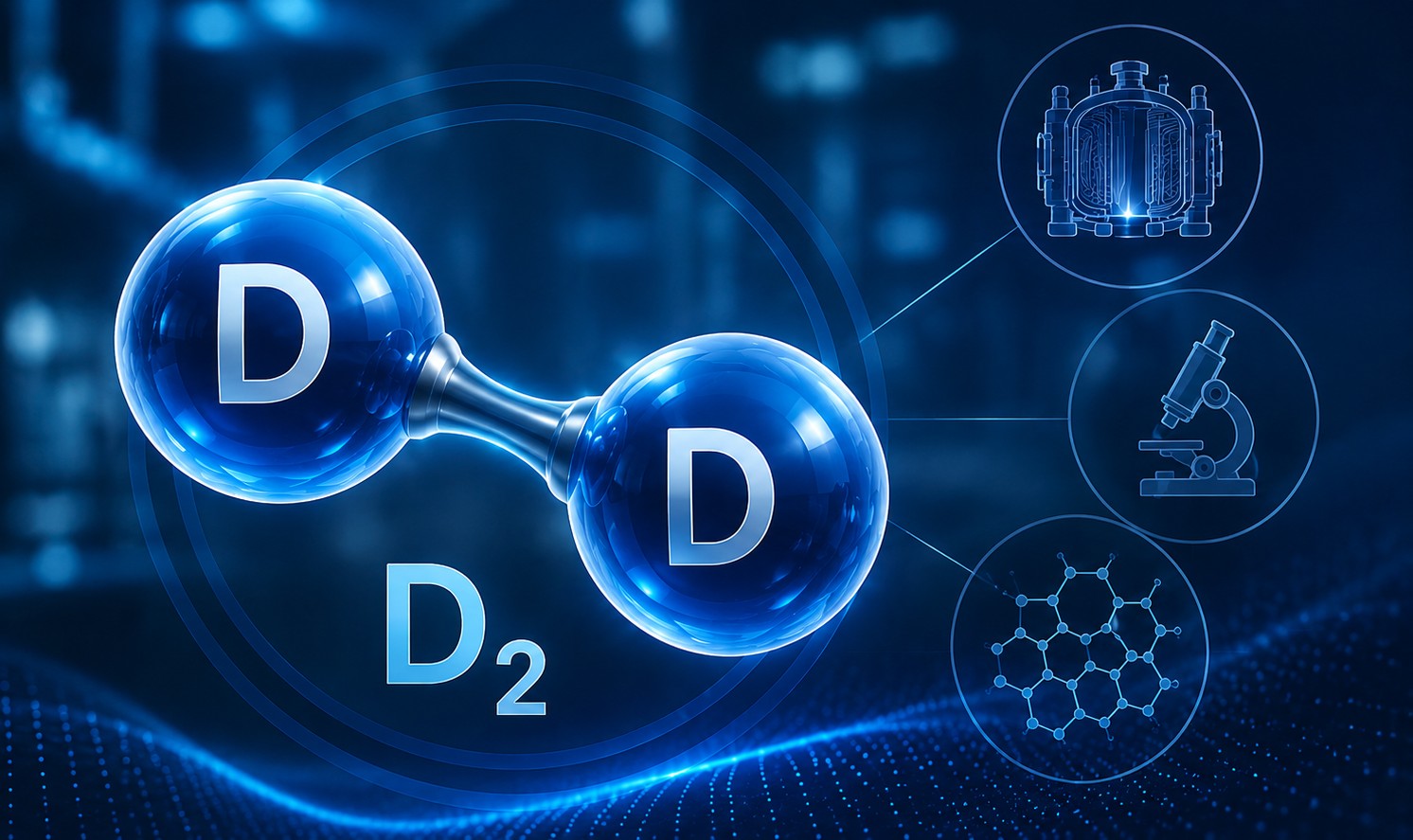 A Key Gas for Advanced Research and Emerging Technologies
Deuterium gas (D₂) is the stable isotopic form of hydrogen, containing one proton and one neutron in its nucleus. With a mass approximately twice that of ordinary hydrogen (H₂), deuterium exhibits distinct isotopic behavior that makes it highly valuable across a broad range of scientific, industrial, and technological applications.
Its unique properties play a critical role in fusion research, plasma physics, materials science, catalysis, surface studies, semiconductor manufacturing, and analytical chemistry. Its clear isotopic distinction from protium enables researchers to investigate molecular interactions, reaction mechanisms, and hydrogen transport phenomena with high precision.
As demand grows for advanced energy systems and next-generation materials, deuterium gas remains an essential resource for scientific innovation worldwide.
Physical Properties and Advantages
Although chemically similar to hydrogen, deuterium exhibits distinct isotopic behavior that makes it highly valuable for research and specialized applications.
Key advantages include:
- Stable, non-radioactive isotope of hydrogen, ensuring safe handling in laboratory and industrial environments
- High isotopic purity available for the most demanding research and analytical applications
- Clear isotopic signature enabling unambiguous differentiation from protium by mass spectrometry and NMR
- Pronounced kinetic isotope effect (KIE), making it a powerful probe for reaction mechanism studies and catalysis research
- Essential fuel for plasma and fusion research, central to international programs targeting controlled nuclear fusion
These properties establish D₂ as a reference gas for high-precision experimental, analytical, and industrial systems.
Why Choose Eurisotop as Your Deuterium Gas Supplier?
As a manufacturer and part of the Cambridge Isotope Laboratories network, Eurisotop provides full control over the entire deuterium gas value chain — from production to final delivery. This integrated expertise ensures consistent product quality, supply reliability, and technical excellence for the most demanding research and industrial applications.
With permanent stock availability, we guarantee fast and reliable global supply, supporting both routine laboratory requirements and critical research programs without interruption.
Our in-house analytical capabilities, supported by advanced instrumentation and certified measurement systems, ensure rigorous control of isotopic purity and gas composition. Every batch is fully analyzed, certified, and traceable according to strict quality standards, ensuring reproducibility and compliance for high-precision applications.
Beyond standard products, Eurisotop also offers custom gas mixtures tailored to customer specifications. We can prepare deuterium-based gas blends at defined concentrations, with full analytical certification, enabling researchers and industrial users to obtain exactly the composition required for their experiments or processes.
Through this combination of manufacturing expertise, guaranteed availability, analytical excellence, and bespoke gas solutions, Eurisotop stands as a trusted global partner for high-purity deuterium gas supply.
Supporting Scientific Innovation
From fusion research and plasma physics to materials science, catalysis, semiconductor manufacturing, and analytical chemistry, deuterium gas enables scientists and engineers to explore fundamental mechanisms and develop next-generation technologies.
Eurisotop provides high-purity deuterium gas solutions designed to meet the stringent requirements of modern research and industrial applications, ensuring reliability, consistency, and performance at every stage.
Deuterium Gas - Scientific and Industrial Applications
Fusion and Plasma Physics Research
Deuterium is one of the primary fuels used in nuclear fusion research. In the deuterium–tritium (D–T) reaction — the basis of most current experimental fusion reactors — deuterium produces 17.6 MeV of energy per reaction with helium as the only by-product. In the deuterium–deuterium (D–D) reaction, D₂ alone can sustain a fusion process, making it relevant for next-generation reactor concepts.
D₂ is employed in fusion and plasma research for:
- Plasma fuel in tokamaks and stellarators: major international programs such as ITER and JET require high-purity D₂ for plasma generation and fuel cycle management
- Neutral beam injection (NBI): D₂ is ionized and accelerated to heat plasma to fusion temperatures in large-scale magnetic confinement devices
- Plasma–material interaction studies: understanding how deuterium behaves at plasma-facing surfaces is essential for the design of fusion reactor components
- Fusion fuel cycle studies and experimental reactor development: supporting both academic programs and the growing private fusion sector
Deuterium remains central to international efforts focused on controlled fusion as a long-term clean energy solution.
Catalysis and Reaction Mechanism Studies
Deuterium gas is extensively used in catalysis and chemical research to investigate reaction pathways and molecular mechanisms. Through kinetic isotope effects, researchers can obtain deeper insight into the elementary steps of chemical transformations.
- Heterogeneous catalysis research: D₂ is used to probe active sites, surface intermediates, and hydrogen activation mechanisms on solid catalysts
- Reaction mechanism elucidation: H/D isotope labeling experiments reveal rate-determining steps and transition state structures in organic and organometallic reactions
- Catalyst performance evaluation: deuterium uptake and exchange experiments provide quantitative data on catalyst activity and selectivity
- Petrochemical and refining research: D₂ is used to study hydrogenation, dehydrogenation, and cracking mechanisms on industrial catalysts such as zeolites and supported metals, supporting the development of more selective and efficient catalytic processes.
Materials Science and Surface Studies
Understanding hydrogen behavior in materials is critical for energy, transport, and advanced manufacturing. Deuterium gas is widely used as a tracer to study hydrogen-related phenomena at the atomic level.
- Hydrogen diffusion in metals and alloys: D₂ enables quantitative tracking of hydrogen transport and trapping in structural materials by NMR, SIMS, and neutron scattering
- Metal embrittlement mechanisms: deuterium tracing supports the investigation of hydrogen-induced cracking in high-strength steels and aerospace alloys
- Thin film deposition and surface modification: deuterium is used as a reactive gas in specialized CVD and plasma-enhanced deposition processes
Semiconductor and Optoelectronics Research
In microelectronics and optoelectronics, deuterium is used to study and mitigate hydrogen-related degradation mechanisms, significantly improving device lifetime and reliability.
- Interface passivation in MOS devices: post-metallization annealing in D₂ replaces Si–H bonds with stronger Si–D bonds at the Si/SiO₂ interface, reducing hot-carrier-induced degradation in power MOSFETs and analog circuits
- OLED lifetime improvement: deuterium incorporation into organic semiconductor layers strengthens C–D bonds against photo-oxidative degradation, extending the operational lifetime of OLED displays and lighting panels — a field directly addressed by Eurisotop's deuterated reagents for optoelectronics
- Hydrogen diffusion in semiconductor materials: D₂ tracing supports the study of hydrogen passivation and activation of dopants in silicon, germanium, and compound semiconductors
Analytical Chemistry and Isotope Ratio Measurements
Deuterium gas is a primary reference material in stable isotope ratio analysis. Its well-defined isotopic composition makes it indispensable for calibrating instruments and validating analytical methods across environmental, food authenticity, and forensic science applications.
- Isotope ratio mass spectrometry (IRMS): D₂ reference gases are used to establish measurement scales for hydrogen isotope analysis (VSMOW scale) in water, organic matter, and geological samples
- Compound-specific D/H analysis (GC-IRMS): D₂ serves as the in-line reference gas during GC-IRMS measurements, supporting food authenticity testing (detection of adulteration in flavors, honey, and wine) and environmental tracing
- Detector calibration and laboratory-scale experiments: D₂ provides a reliable, well-characterized reference gas for advanced spectroscopic and physical measurements
NMR Spectroscopy Applications
Beyond its role in the production of deuterated solvents, deuterium gas itself finds specific applications in advanced NMR experiments and spectroscopic research.
- Frequency lock in gas-phase and supercritical fluid NMR: D₂ provides the deuterium lock signal in specialized NMR probes designed for high-pressure or supercritical fluid measurements
- In situ H/D exchange experiments: D₂ gas is used to probe reaction intermediates, catalytic active sites, and hydrogen bonding networks by monitoring deuterium incorporation via ¹H or ²H NMR
