SILAC
Metabolic labeling of cultured cells for accurate quantitative proteomics
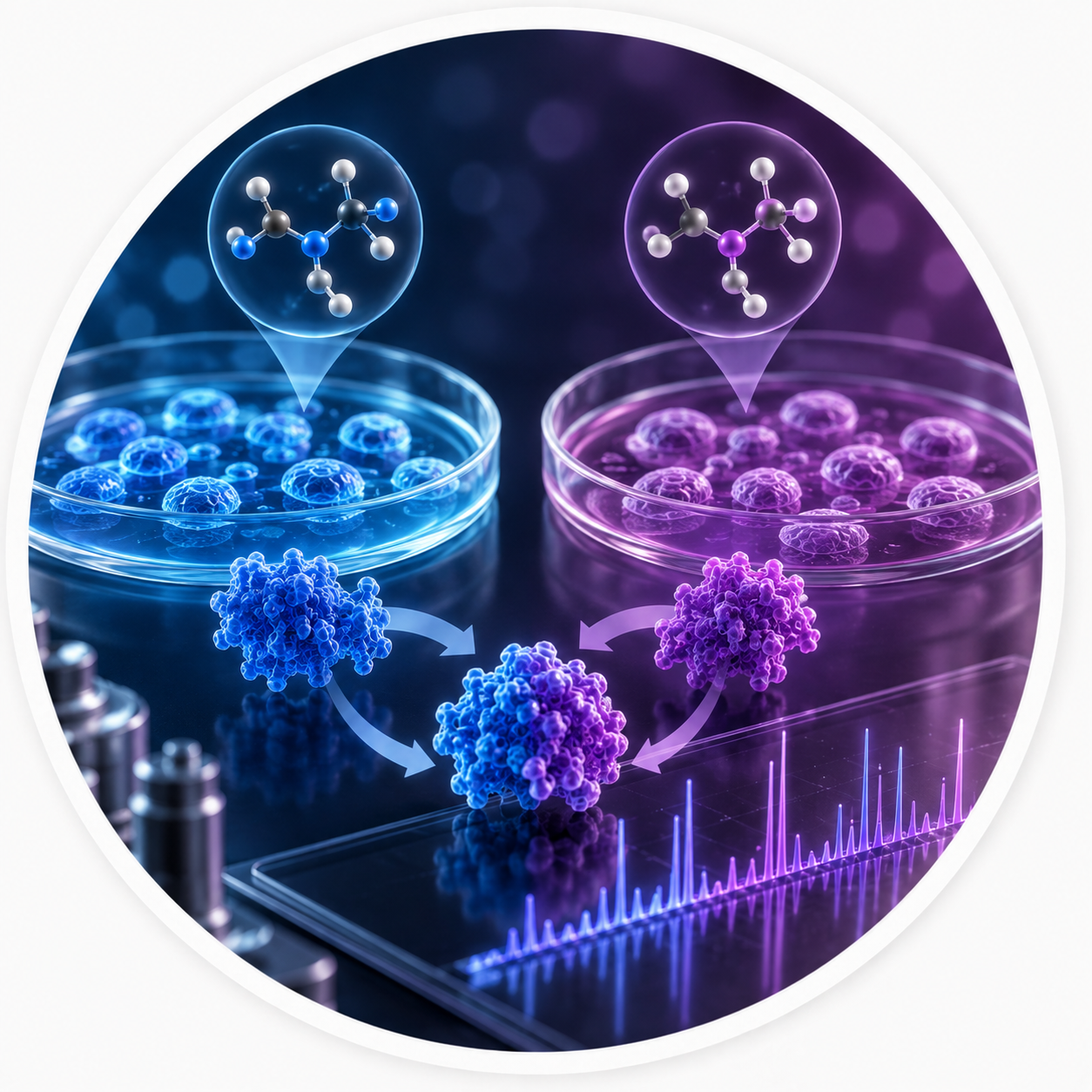
SILAC refers to labeling cultured cells with heavy amino acids for quantitative proteomic analysis. Labeling an entire proteome with heavy amino acids in vivo generates an ideal standard for quantitative proteomics.
When a heavy labeled proteome is mixed with an unlabeled proteome then digested, every unlabeled peptide identified by the mass spectrometer can be quantified by its corresponding heavy peptide. In SILAC, the tryptic amino acids, arginine (R) and lysine (K), contain heavy stable isotopes, so if digesting with trypsin, every peptide is labeled. This metabolic labeling strategy has been employed by hundreds of proteomic studies.
The advantage of metabolic labeling over in vitro tagging techniques is that the heavy and unlabeled samples are mixed before sample preparation, preventing variability between preparations from distorting the quantitation results. This is especially important for extensive sample preparation (e.g., isolation of an organelle).
Arginine (Arg10)
In vivo mixing
Selected References
- Liao, L.; McClatchy, D.B.; Park, S.K.; Xu, T.; Lu, B.; Yates III, J.R. 2008. Quantitative analysis of brain nuclear phosphoproteins identifies developmentally regulated phosphorylation events. J Proteome Res, 7(11), 4743–4755. View on PubMed
- Gonneaud, A.; Jones, C.; Turgeon, N.; et al. 2016. A SILAC-based method for quantitative proteomic analysis of intestinal organoids. Sci Rep, 6, 38195. PMID: 27901089
- Gong, J.; Körner, R.; Gaitanos, L.; et al. 2016. Exosomes mediate cell contact-independent ephrin-Eph signaling during axon guidance. J Cell Biol, 214(1), 35–44. PMID: 27354374
- HILAQ: a novel strategy for newly synthesized protein quantification. J Proteome Res, 16(6), 2213–2220. PMID: 28437088
Related products
Technical Product Information